Reach Truck AGV vs Traditional Reach Truck: What Are the Differences?
Release time: 2026-08-06
As warehouses continue to move toward automation, companies are increasingly comparing Reach Truck AGVs with traditional reach trucks to determine the best solution for their material handling needs.
Both equipment types are designed for pallet storage and retrieval in warehouse environments, especially in applications requiring high lifting performance and efficient space utilization. However, they differ significantly in terms of operation mode, labor requirements, flexibility, safety, and long-term operating efficiency.
Understanding the differences between a Reach Truck AGV and a traditional reach truck can help businesses choose the right solution for modern warehouse automation.
What Is a Traditional Reach Truck?
A traditional reach truck is a manually operated forklift designed primarily for narrow-aisle pallet handling. It uses a retractable mast system that allows the forks to extend forward for pallet placement and retrieval while maintaining a compact turning radius.
Traditional reach trucks are widely used in warehouses, distribution centers, manufacturing facilities, and storage applications where efficient use of vertical space is required.
Their main advantages include:
- High lifting capability
- Good maneuverability in narrow aisles
- Flexible operation controlled by drivers
- Lower initial investment compared with automated solutions
However, traditional reach trucks also depend heavily on skilled operators. Their efficiency can be affected by factors such as operator availability, driving experience, fatigue, and human errors.
What Is a Reach Truck AGV?
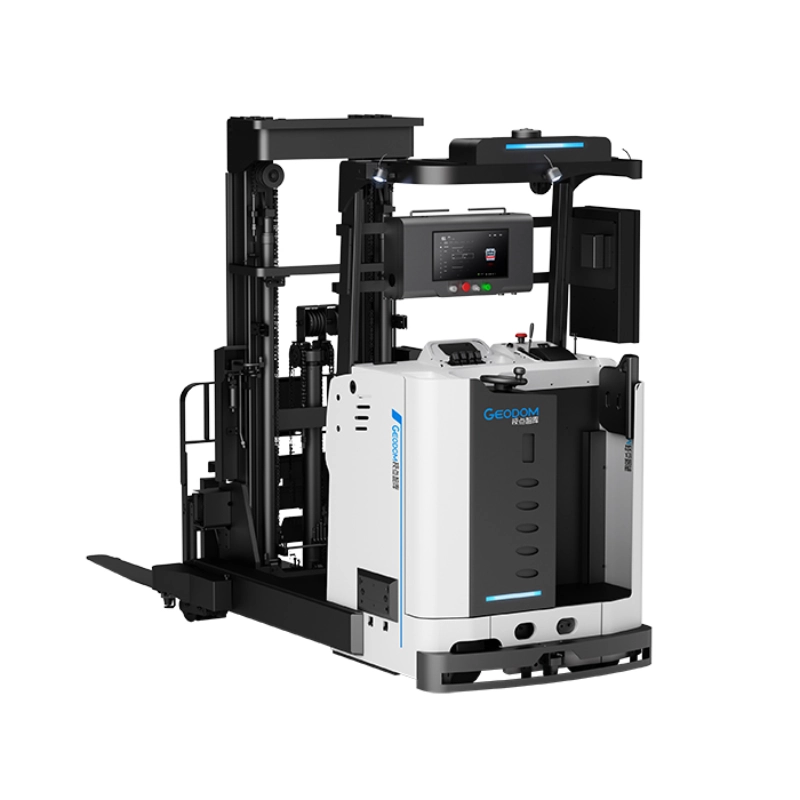
A Reach Truck AGV (Automated Guided Vehicle) is an automated version of a reach truck that combines traditional reach truck functions with autonomous navigation and intelligent control technologies.
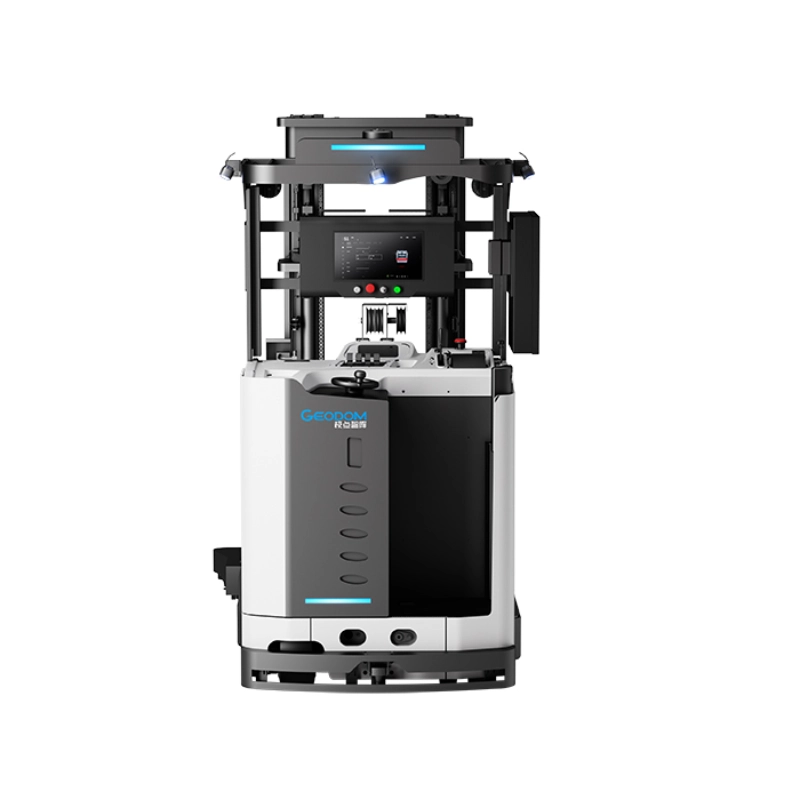
Unlike manually operated equipment, a Reach Truck AGV can transport, store, and retrieve pallets automatically according to warehouse tasks assigned by control systems.
Depending on the application, Reach Truck AGVs may use technologies such as:
- Laser navigation
- SLAM navigation
- Sensor fusion
- Automatic obstacle detection
- Intelligent path planning
- Warehouse management system integration
These technologies allow the equipment to operate independently and become part of a larger automated warehouse system.
Reach Truck AGV vs Traditional Reach Truck: Key Differences
1. Operation Mode and Labor Requirements
The most obvious difference between the two solutions is how they operate.
Traditional reach trucks require a professional operator to control every movement, including driving, positioning, pallet picking, and storage operations. This provides flexibility but also creates dependence on labor availability.
Reach Truck AGVs perform these operations automatically based on programmed tasks. After receiving instructions from warehouse systems, the vehicle can complete transportation and storage operations with minimal human intervention.
For warehouses with repetitive pallet movements or continuous operation requirements, automated reach trucks can significantly reduce labor dependency and improve workflow stability.
2. Warehouse Efficiency and Productivity
Traditional reach trucks rely on operator performance, meaning efficiency can vary depending on experience, working conditions, and workload.
Reach Truck AGVs provide more consistent performance because they follow optimized routes and execute standardized operations. This helps reduce unnecessary movement, improve task accuracy, and maintain stable material flow.
In high-volume warehouses, automated reach trucks can help improve:
- Pallet handling consistency
- Storage and retrieval efficiency
- Equipment utilization
- Overall warehouse productivity
For businesses looking to build smart warehouses, Reach Truck AGVs provide a scalable approach to improving operational efficiency.
3. Accuracy and Positioning Performance
Accurate pallet placement is critical in high-density warehouses, especially when operating with narrow aisles and high-level storage racks.
Traditional reach trucks depend on operator skill to position pallets correctly. Experienced drivers can achieve high accuracy, but performance may vary between operators.
Laser SLAM Reach Truck AGVs use intelligent navigation and positioning technologies to achieve consistent movement accuracy. This is particularly valuable in automated storage environments where precise pallet placement is required.
Stable positioning helps reduce:
- Incorrect pallet placement
- Rack impact risks
- Product handling errors
- Operational interruptions
4. Safety and Risk Management
Safety is another important difference between automated and traditional reach trucks.
Traditional reach trucks require operators to make decisions during every movement. Although trained drivers can operate safely, risks may still occur due to fatigue, limited visibility, or incorrect operation.
Reach Truck AGVs are equipped with intelligent safety systems, including:
- Obstacle detection
- Emergency stopping
- Automatic speed control
- Safety sensors
- Collision avoidance functions
These technologies help create a safer working environment, especially in warehouses where multiple vehicles, workers, and automated systems operate together.
5. Flexibility and Automation Integration
Traditional reach trucks provide excellent flexibility because operators can quickly respond to changing warehouse conditions. They are suitable for environments where tasks change frequently and automation requirements are limited.
However, Reach Truck AGVs provide stronger integration capabilities. They can communicate with:
- Warehouse Management Systems (WMS)
- Warehouse Control Systems (WCS)
This allows companies to create coordinated warehouse automation processes instead of relying on independent equipment.
6. Long-Term Operating Cost and Return on Investment
Traditional reach trucks usually have lower initial purchase costs. However, businesses need to consider long-term expenses such as:
- Operator wages
- Training costs
- Shift management
- Productivity limitations
- Safety management
Reach Truck AGVs require a higher initial investment due to automation technology and system integration. However, they can provide long-term benefits through:
- Reduced labor dependency
- Higher operational consistency
- Improved warehouse utilization
- Reduced handling errors
- Support for continuous operation
For warehouses with stable and repetitive workflows, the long-term ROI of automated reach trucks can be significant.
Which One Should You Choose: Reach Truck AGV or Traditional Reach Truck?
The right choice depends on the warehouse environment, operational requirements, and future automation strategy.
A traditional reach truck may be suitable for:
- Small warehouses
- Flexible material handling operations
- Low-volume pallet movement
- Facilities with available forklift operators
A Reach Truck AGV is more suitable for:
- High-density warehouses
- Automated storage systems
- Large distribution centers
- Manufacturing logistics
- 24/7 warehouse operations
- Businesses planning smart warehouse upgrades
Many companies also choose a gradual automation approach by combining traditional equipment with automated solutions during warehouse transformation.
Geodom Reach Truck AGV Solution
Geodom provides intelligent material handling solutions designed for modern warehouse automation. Its Reach Truck AGV combines the capabilities of traditional reach trucks with autonomous navigation and intelligent control technologies.
Designed for narrow-aisle and high-density storage applications, Geodom Reach Truck AGV solutions help businesses improve pallet handling efficiency, optimize warehouse space utilization, and reduce dependence on manual forklift operations.
By integrating with warehouse management systems and other automation equipment, Geodom helps companies build flexible and scalable smart logistics systems.
Frequently Asked Questions About Reach Truck AGV
What is the main difference between a Reach Truck AGV and a traditional reach truck?
The main difference is the operation method. Traditional reach trucks require human operators, while Reach Truck AGVs use autonomous navigation and intelligent control systems to perform pallet handling tasks automatically.
Are Reach Truck AGVs better than traditional reach trucks?
It depends on the application. Reach Truck AGVs are more suitable for high-volume, repetitive, and automated warehouse operations, while traditional reach trucks remain useful for flexible manual handling environments.
Can a Reach Truck AGV work in narrow aisles?
Yes. Reach Truck AGVs are designed for narrow-aisle warehouse applications and can support high-density pallet storage environments.
Are Reach Truck AGVs suitable for existing warehouses?
Yes. Many existing warehouses can introduce Reach Truck AGVs as part of a phased automation strategy, depending on warehouse layout, rack systems, and operational requirements.
Conclusion
Both traditional reach trucks and Reach Truck AGVs play important roles in warehouse material handling. Traditional reach trucks provide flexibility and lower initial costs, while Reach Truck AGVs offer higher automation, consistency, and scalability.
As warehouses become more intelligent and space utilization becomes increasingly important, Reach Truck AGVs are becoming a valuable solution for companies seeking improved efficiency, safer operations, and long-term automation development.
By selecting the right material handling technology, businesses can create more efficient and future-ready warehouse environments.