Latent Lifting AMR vs. Forklift AGV: Which Is Better for Intralogistics?
Release time: 2026-10-30
Table of Contents
The key to choosing between a latent lifting AMR and a forklift AGV is understanding how materials are picked up, moved, and handed over at each stage of the workflow. Both can help reduce repetitive manual transport, but they are not interchangeable in every warehouse or factory. The right option depends on the loads being moved, the available floor space, the design of storage and production stations, and how materials enter and leave the transport system.
For warehouse managers, the decision should start with the actual material flow rather than the robot category. Does the task involve moving a compatible carrier between fixed stations, or does it require fork-based pickup from pallets and storage positions? How much space is available for maneuvering, and how consistent are the pickup points? These questions help narrow down the options before comparing cost, cycle time, and integration requirements. AutoFork Robotics offers a Latent Lifting AMR product category for businesses exploring mobile automation. Before selecting a specific model, buyers should verify its lifting mechanism, load rating, and supported carriers against the requirements of their facility.
How Latent Lifting AMRs and Forklift AGVs Handle Materials
A latent lifting AMR is generally designed to move beneath a compatible carrier or load-handling fixture and lift it using an integrated lifting mechanism. Depending on the model and system design, the carrier may then travel with the robot between designated stations. This approach can work well for repetitive transfers when the load interface, pickup position, and drop-off point are clearly defined. It is important to check the specific product design, since lifting height, carrier compatibility, and payload capacity vary between models.
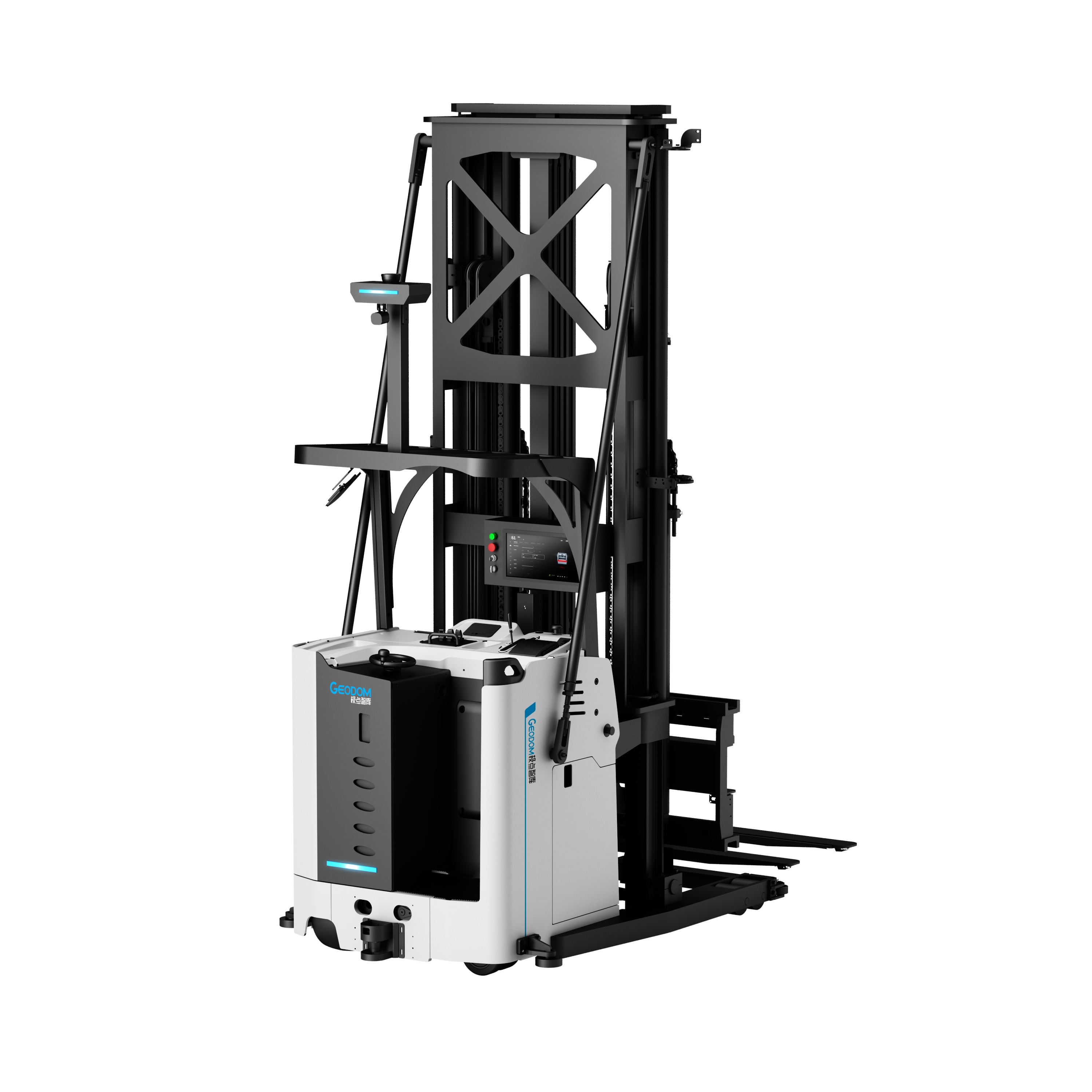
A forklift AGV uses a different handling approach. It typically uses forks to engage a compatible pallet or load and transport it to another location. This can make it suitable for workflows where loads must be lifted from floor-level pickup points or positioned at different heights, provided the selected model supports those tasks. The required fork dimensions, load center, lift height, and rated capacity all need to match the application.
When comparing the two, focus on the full handling sequence, not just the robot’s movement. A latent lifting design may simplify transfers between prepared stations, while a forklift-style design may suit operations requiring fork-based pickup and placement. Neither is automatically the better choice for every intralogistics setup.
AMR vs. Forklift AGV: Space Requirements and Factory Layout
Floor space can influence the decision just as much as payload capacity. A robot may be able to carry the required load, but if it cannot maneuver comfortably around racks, workstations, or shared traffic areas, the overall workflow may still be inefficient. Compare the vehicle’s dimensions, turning behavior, approach direction, and required clearance with the actual layout before committing to a design.
A latent lifting system may suit facilities where compatible carriers can be positioned at predictable pickup and drop-off points. However, the space needed to approach a carrier and move beneath it must be considered. The carrier’s base design, floor clearance, and positioning tolerance can affect whether the robot can complete the pickup reliably. A forklift AGV, meanwhile, needs enough clearance to approach the load with its forks and maneuver safely while carrying it. Its turning path and fork approach requirements can vary considerably by model.
For either option, evaluate the narrowest aisle, the busiest intersection, and the most constrained transfer station. Consider people, other mobile robots, and temporary obstructions as well as the static layout. A route that works on a drawing may need adjustment after real traffic patterns are taken into account. The best solution is the one that completes the full transport cycle reliably within the available space.
Loading and Unloading: Where the Workflow Makes the Difference
Loading and unloading arrangements often determine which robot type is the better fit. With a latent lifting system, the carrier must be compatible with the robot’s lifting mechanism and provide suitable access underneath. The pickup and drop-off stations also need to be designed around the robot’s operating requirements. If carriers arrive at inconsistent positions or have different base structures, additional alignment measures or station adjustments may be necessary.
A forklift AGV relies on fork engagement, so the pallet or load must provide appropriate fork access. Buyers should confirm the fork dimensions, load center, clearance, and required lifting height. If the task involves placing loads onto racks or retrieving them from elevated positions, the selected vehicle must be specifically designed and rated for that work. Not every forklift AGV supports the same lift heights or load configurations.
When planning automated material transport, map each handover point from the source location to the destination. Identify how materials arrive, how the robot collects them, and how the receiving station confirms that the transfer is complete. Also consider exceptions, such as a missing carrier or a blocked station. Designing these details early helps prevent a common automation problem: choosing a robot that can move the load but does not fit the surrounding process.
Which Robot Is Better for Different Intralogistics Tasks?
There is no universal winner in the AMR vs forklift AGV comparison. The most suitable option depends on the type of load, the pickup method, the layout, and the work that happens before and after each transfer.
| Application requirement | Latent lifting AMR | Forklift AGV |
| Moving compatible carriers between fixed stations | Worth evaluating | May also be suitable |
| Picking up loads using forks | Depends on the specific lifting design | A natural fit when fork and load specifications match |
| Handling loads at different heights | Verify the model’s lifting range | Verify rated lift height and capacity |
| Working in restricted spaces | Check under-carrier access and maneuvering clearance | Check fork approach and turning clearance |
| Integrating with existing production workflows | Assess carrier and station compatibility | Assess pallet, rack, and station compatibility |
For production lines that repeatedly move compatible carriers between workstations, a latent lifting AMR may be worth evaluating. For pallet workflows that require fork-based pickup and placement, a forklift AGV may be more appropriate. Mixed operations may call for a combination of equipment rather than forcing one vehicle type to perform every task.
A factory material handling robot should be selected according to real operating conditions, not assumptions based on its name. Before making a decision, confirm the maximum load, carrier dimensions, required lift height, travel distance, throughput target, and station interface. This creates a more useful comparison than relying on a general claim that one technology is faster or more space-efficient.
What to Check Before Choosing a Latent Lifting AMR
Before purchasing a latent lifting AMR, prepare a clear specification for the intended application. Start with the load itself: its weight, dimensions, center of gravity, and the carrier or fixture used to support it. For a latent lifting design, confirm how the robot engages with the carrier, what clearance is required underneath, and how the load is secured during movement.
Next, review the operating environment. Document aisle widths, floor conditions, slopes, transfer distances, pickup locations, and expected traffic. Ask the supplier to confirm the model’s rated payload, lifting height, positioning accuracy, navigation method, battery runtime, and charging requirements. These values should come from the specific product documentation rather than being assumed from the general AMR category.
Finally, assess integration and safety. Determine whether the robot needs to exchange tasks and status information with a warehouse management system (WMS), manufacturing execution system (MES), or central dispatching platform. Confirm how the system handles obstacles, blocked routes, and failed handovers. AutoFork Robotics offers a Latent Lifting AMR product category, but buyers should request model-specific specifications before confirming suitability.
FAQ
What is the main difference between a latent lifting AMR and a forklift AGV?
A latent lifting AMR generally lifts a compatible carrier from underneath, while a forklift AGV typically uses forks to engage and transport a suitable load. The actual capabilities depend on the selected model.
Is a latent lifting AMR always better for narrow aisles?
No. A latent lifting design may suit certain layouts, but aisle suitability depends on vehicle dimensions, carrier access, turning behavior, and the space required for pickup and drop-off. Compare the complete operating envelope before deciding.
What should I confirm before buying a latent lifting AMR?
Confirm the rated payload, lifting mechanism, compatible carriers, clearance requirements, positioning accuracy, navigation method, operating time, charging method, and system interfaces. Test the proposed configuration against the real load and transfer stations whenever possible.
Can a latent lifting AMR replace a forklift AGV completely?
Not necessarily. If the facility requires fork-based pallet pickup, elevated placement, or multiple handling heights, a suitable forklift AGV may remain the better option. Some operations may benefit from using both types for different tasks.